
Dofollow vs Sponsored Links: What Google Says and What Still Moves Rankings
Dofollow, nofollow, sponsored and ugc explained in plain English: what Google's documentation says about paid links, where the real risks are and how to reduce them.
If you order guest posts, you will hear the same question again and again: “Is the link dofollow?” Many buyers treat it as the only thing that matters. Many publishers charge extra for it. And a lot of confusing advice surrounds what Google actually says about it.
This guide explains the link attributes in plain English, what Google’s own documentation says about paid links, where the real risks are, and what still helps your rankings. We sell guest post placements ourselves, so we have a stake in this topic. We will still give you the straight version, because buyers who understand the rules make better decisions.
Key takeaways
- “Dofollow” is just a normal link. Nofollow, sponsored and ugc are attributes that qualify a link.
- Google asks for paid links to be marked sponsored or nofollow, and treats these attributes as hints.
- Paid followed links break Google’s spam policies. The real-world risk depends heavily on how you buy them.
- Relevant sites, natural anchors, real articles and a steady pace keep risk low.
The four types of link
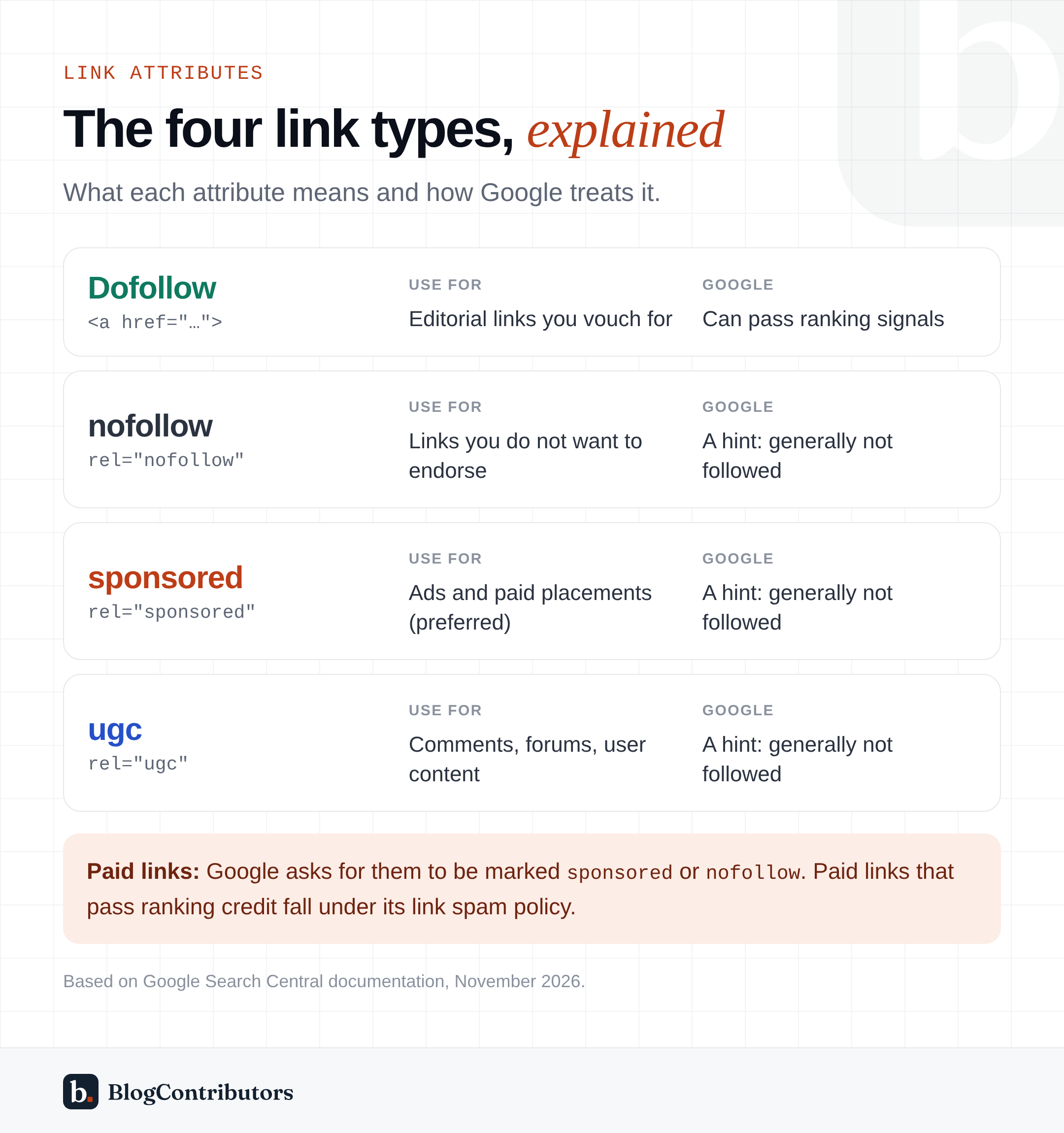
When one website links to another, the HTML link can carry a rel attribute that tells search engines about the relationship. There are four common cases:
Dofollow (a normal link)
There is no actual “dofollow” attribute. A dofollow link is simply a normal link with no rel value that restricts it. Search engines can follow it, and it can pass ranking signals to the page it points to. When people say “dofollow”, they mean “a normal link”.
rel=”nofollow”
Nofollow has been around since 2005. It tells search engines that the site does not want to vouch for the linked page. For years it was the standard way to mark paid links, comment links and anything a site did not want to endorse.
rel=”sponsored”
Google introduced sponsored in 2019 for links that are advertisements or paid placements. Google’s documentation says to use it to “mark links that are advertisements or paid placements”. Nofollow is still an acceptable way to mark them, but sponsored is preferred.
rel=”ugc”
Also added in 2019, ugc stands for user-generated content. It is meant for links in comments, forum posts and other content written by users rather than the site’s own team. Sites can drop it for trusted, long-standing contributors.
The values can be combined, such as rel="sponsored nofollow".
“Hints”, not commands
Before 2019, Google generally treated nofollow as an instruction not to count a link. When Google introduced sponsored and ugc, it also changed how all three are treated. They became hints. Google uses them as signals, alongside everything else it knows, to decide whether to count a link for ranking and whether to crawl it.
In practice, Google’s documentation says links with these attributes “will generally not be followed”. So a nofollow or sponsored link may pass some value, but you should not pay for one assuming it will. Any value it passes is a bonus, not a promise.
What Google says about paid links
This is the part much of the guest posting industry glosses over. Google’s spam policies list “link spam” as a violation. The examples include:
- exchanging money, goods or services for links meant to pass ranking credit, including paid posts that contain links,
- “guest posts or press releases with keyword-optimized anchor text” placed on other sites to pass ranking credit, and
- low-value content created mainly to manipulate links and rankings.
Google also says paid links are not a violation when they are marked with rel="nofollow" or rel="sponsored".
Put simply: under Google’s rules, a paid guest post with a normal, followed link is a link scheme. That is true whether you pay the publisher directly or pay a service like ours. No honest provider can tell you otherwise.
So why do so many brands still use dofollow guest posts?
Because many SEOs find that well-placed followed links still help, and a paid guest post is often hard to tell apart from an editorial one. A well-written article on a relevant, real publication, with a natural link in context, looks much like content the site would have published anyway.
The risk is not zero, though. It depends heavily on how you do it.
What gets penalised
Google’s actions against link schemes tend to target patterns, not single links:
- large volumes of guest posts with exact-match commercial anchor text,
- links from sites that obviously sell to anyone, with hundreds of unrelated outbound links,
- thin articles written only to hold a link, and
- sudden spikes of links from low-quality sources.
When Google detects these patterns, it may simply ignore the links, or it may take manual action against the site that bought or sold them. Sites that sell links at scale can also lose their rankings. When that happens, the links they sold lose most of their value overnight.
Site reputation abuse
In 2024 Google added a related policy called site reputation abuse. It targets third-party content published on an established site mainly to benefit from that site’s ranking signals. It mostly affects sites that host large sections of unrelated paid content, such as coupon sections on news sites. It is one more reason to avoid sites whose content has clearly drifted into “anything for a fee”.
How to reduce your risk
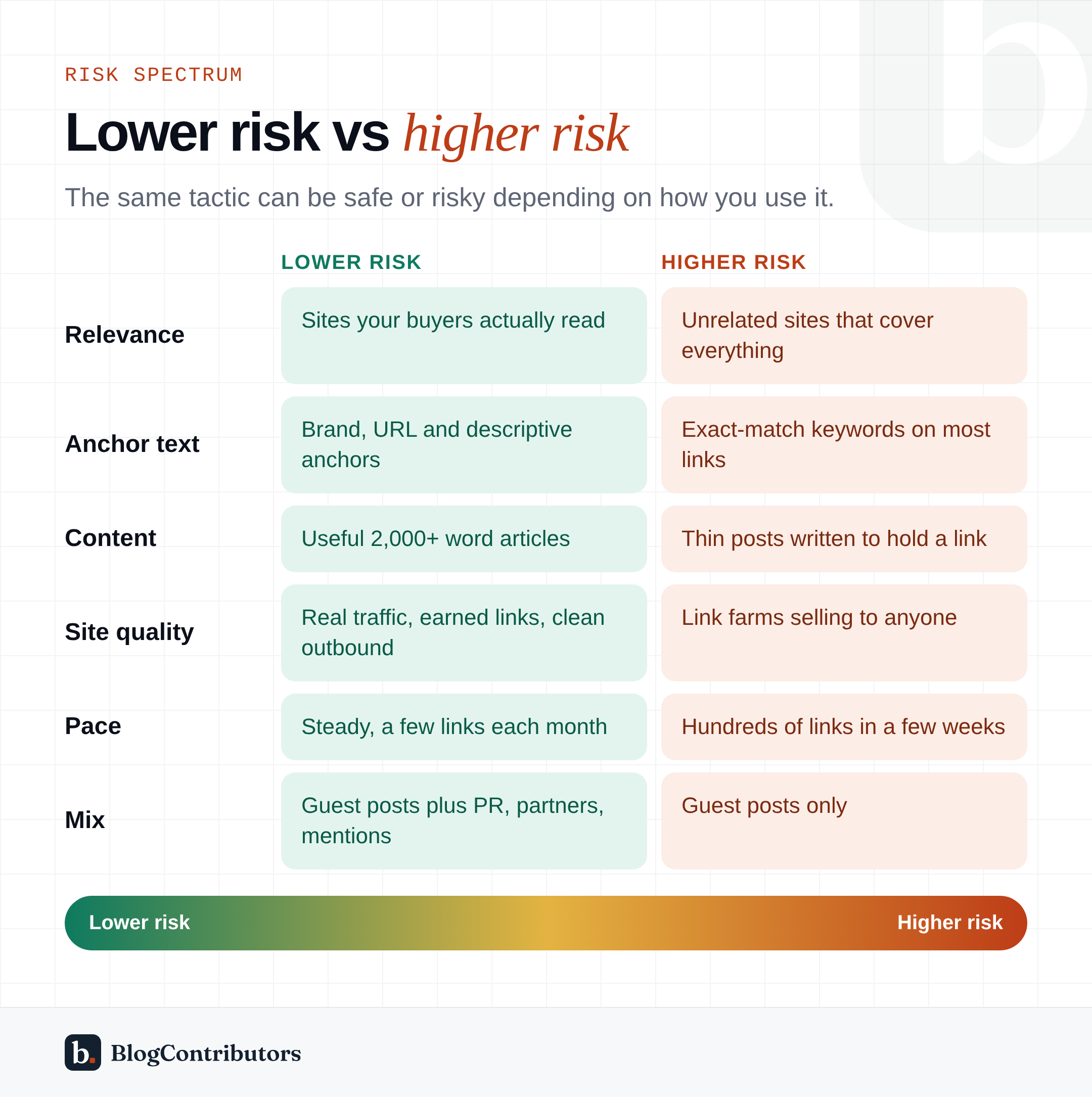
If you choose guest posts with followed links, these practices keep you much closer to what a natural link profile looks like:
1. Choose relevant sites
A link from a site your customers actually read is easy to justify to anyone, including a search engine reviewer. A link from an unrelated site that covers everything is not.
2. Keep anchor text natural
Use your brand name, the page title, the plain URL or a descriptive phrase most of the time. Save exact-match keywords like “best payroll software” for a small share of links. Google’s policy explicitly calls out guest posts with “keyword-optimized anchor text”.
3. Publish articles worth reading
A useful 2,000-word article that answers a real question is valuable content in its own right. That is why we write every article ourselves at 2,000–2,500 words, instead of accepting a thin post written only to hold a link.
4. Avoid link farms
Run every site through a vetting process before you buy. Our 12-point checklist covers outbound links, traffic trends and the other signals that separate real publications from link shops.
5. Build slowly and mix your sources
A real brand earns links from many places over time: press, partners, directories, podcasts, customers and content people share. Guest posts should be one part of that mix, added at a steady pace, not hundreds in a month.
What a natural link profile looks like
It helps to picture what Google sees when it looks at a healthy brand’s backlinks. A natural profile usually has:
- A mix of link types. Most well-known sites have a meaningful share of nofollow links from social profiles, forums, news coverage and comments. A profile with 100% followed links is unusual.
- Mostly branded and URL anchors. People link to companies by name far more often than with keyword phrases.
- Links to many pages. Natural links go to the homepage, blog posts, tools and resources, not just to one commercial page.
- Varied sources. Big publications, small blogs, directories, partners and customers, in different countries and niches close to the brand.
- Gradual growth. New links arrive steadily, with spikes around launches or news, not hundreds in a single week from sites that all look the same.
Every guest post you buy should fit into that picture, not stand out from it.
Anchor text examples: safer vs riskier
Say you sell scheduling software under the brand “YourBrand”. Here is how the same link could be anchored:
| Anchor text | Type | Risk |
|---|---|---|
| “Calendly alternatives like YourBrand” | Branded, descriptive | Low |
| “yourbrand.com” | URL | Low |
| “this guide to scheduling for remote teams” | Descriptive | Low |
| “a scheduling tool for clinics” | Partial match | Medium |
| “best scheduling software” | Exact match, commercial | Higher |
The last example is not forbidden, but if many of your guest posts use anchors like it, the pattern becomes easy to spot.
Are sponsored or nofollow links worth paying for?
They can be, just not for the same reason. A nofollow or sponsored link on a high-traffic, relevant site can:
- send real referral visitors who are interested in your topic,
- build brand awareness and help your name show up when people research your category,
- diversify your link profile, because natural profiles always include a share of nofollow links, and
- carry no policy risk, because the link is correctly marked.
Because they pass less ranking value, they should cost less. If a site charges the same for a sponsored link as for a followed one, ask why.
How to check a link’s attribute yourself
You do not need special tools to confirm what you paid for. When your guest post goes live:
- Open the article in Chrome, right-click your link and choose Inspect.
- Look at the highlighted
<a>tag in the code panel. - If there is no
relattribute, or it only contains values likenoopenerornoreferrer, it is a normal followed link. - If you see
nofollow,sponsoredorugc, the link is qualified.
Also check the page itself. A noindex meta tag in the page’s source means Google is asked not to index the page at all, which matters far more than the link attribute. Recheck both a few weeks later, because links on some sites are changed quietly after publication.
How we handle link types
Each listing in our marketplace states its link type up front. Of the 63 sites currently listed, 58 offer followed links and 5 offer nofollow links. You can filter by link type, so you always know what you are getting before you order.
We verify the link attribute when the post goes live and send you the live URL. If the published link does not match what the listing says, we sort it out with the publisher.
We also turn down orders for gambling, adult, CBD and crypto sites. Those niches carry far more risk for both the buyer and the publisher.
Frequently asked questions
Will one paid guest post get my site penalised?
Very unlikely. Google’s actions against link schemes target patterns across many links. The bigger risk with a single bad placement is that Google simply ignores the link and your money is wasted.
What happens if Google decides a link is unnatural?
Most often, Google discounts it, meaning it passes no value. In more serious cases, Google can apply a manual action, which appears in Search Console. If you receive one, you remove or disavow the unnatural links and file a reconsideration request.
Should I disavow links preemptively?
Google’s general advice is that most sites never need the disavow tool. Use it only if you have a manual action, or you know you have a large number of spammy or paid links that you cannot get removed.
Should I ask for the sponsored tag?
If you want to follow Google’s guidelines strictly, yes. A sponsored placement on a relevant, high-traffic site still brings readers, brand exposure and diversity to your link profile. Many brands use a mix: sponsored links for clearly promotional content, and editorial-style articles for educational topics.
The bottom line
- “Dofollow” just means a normal link with no restricting
relvalue. - Google wants paid links marked
sponsoredornofollow. Paid followed links are against its spam policies. - Nofollow, sponsored and ugc are hints, so marked links may still pass some value, but do not count on it.
- Many sites still use paid followed links, but the risk depends on how you buy them. Relevant sites, natural anchors, real articles and a steady pace keep that risk low.
- Sponsored and nofollow placements have their own value: referral traffic, brand reach and a natural link profile.
Make the decision with your eyes open. If you are ready to look at real sites with clearly stated link types, browse the marketplace or read how our process works.
This article summarises Google’s public documentation as of November 2026. Search engine policies change, so always check Google Search Central for the latest guidance before you make decisions.