
How to Judge a Guest Post Site Before You Pay (12 Checks We Run on Every Listing)
The 12 checks we run on every website before it is listed: traffic, authority, content and placement, plus the red flags that mean you should walk away.
Most guest post sites look fine at first glance. They have a clean theme, a Domain Rating in the 70s and a “Write for us” page that promises a dofollow link. Many of them are worth almost nothing.
Your money goes to the publisher before you see any result. The only protection you have is the checking you do before you pay. This guide walks through the 12 checks we run on every website before it appears in our marketplace. It also explains what each check tells you, and the red flags that should make you walk away.
You can run every one of these yourself with an Ahrefs or Semrush account, a browser and about fifteen minutes per site.
Key takeaways
- No single metric proves a site is worth paying for. Good sites pass many checks together.
- Real organic traffic, earned backlinks, a clean outbound profile and topical fit matter most.
- Agree the link type, placement and permanence before you pay, and check the link after it goes live.
Why vetting matters more than the metric on the listing
Every third-party metric can be gamed. Domain Rating (DR) measures the strength of a site’s backlink profile, and backlinks can be bought, swapped or built from networks of sites that exist only to link to each other. Traffic estimates can be lifted for a few months by ranking for keywords that bring no real readers. Even “real” sites change hands, get sold to link sellers and slowly fill with paid articles.
That is why no single number is enough. Good sites pass the checks below together. A site that looks great on one metric but fails three other checks is usually a site built to sell links, not a publication that happens to accept guest posts.
We group the checks into four areas: traffic, authority, content and placement.
Traffic checks
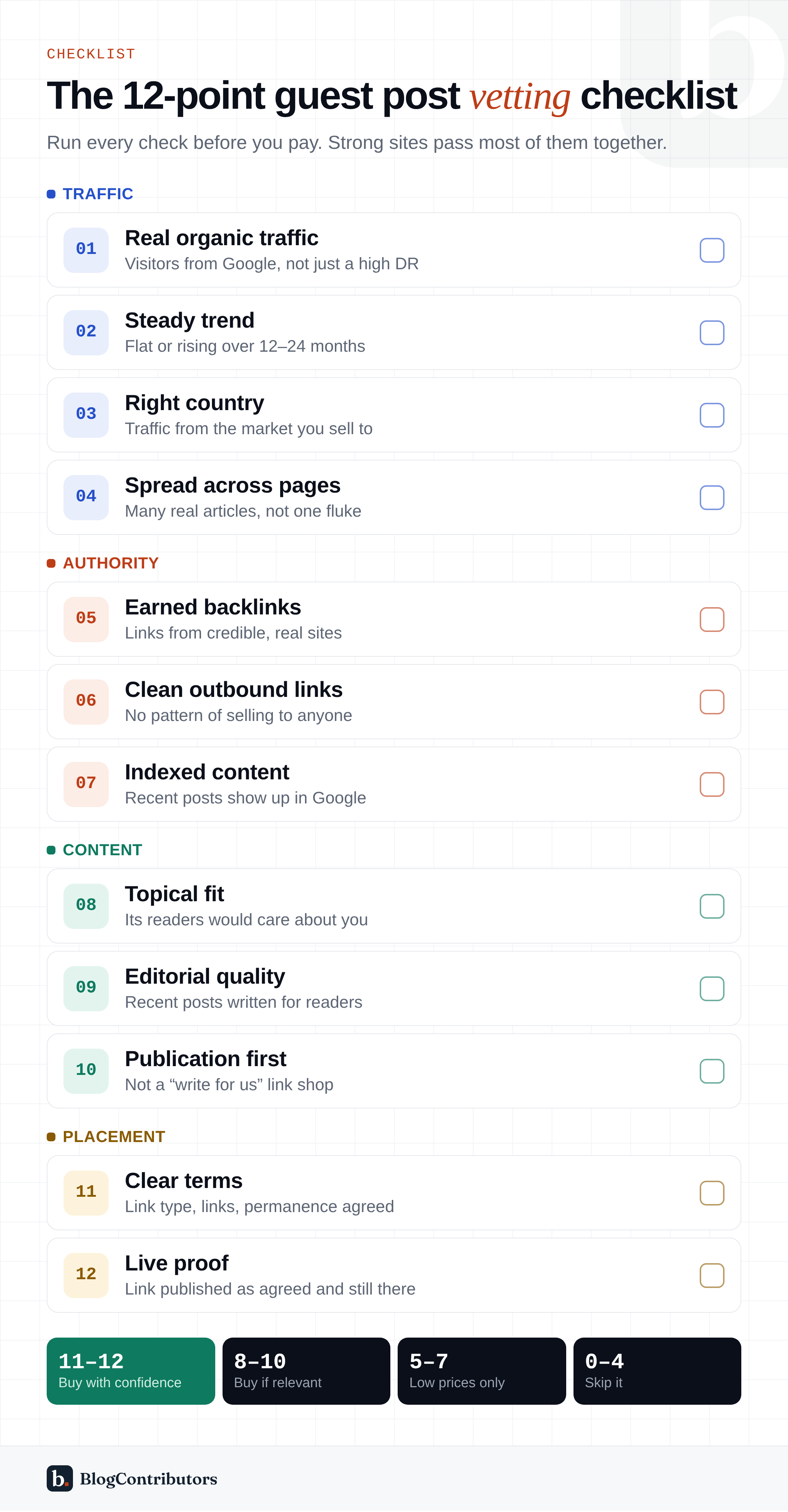
1. Real organic traffic, not just a high DR
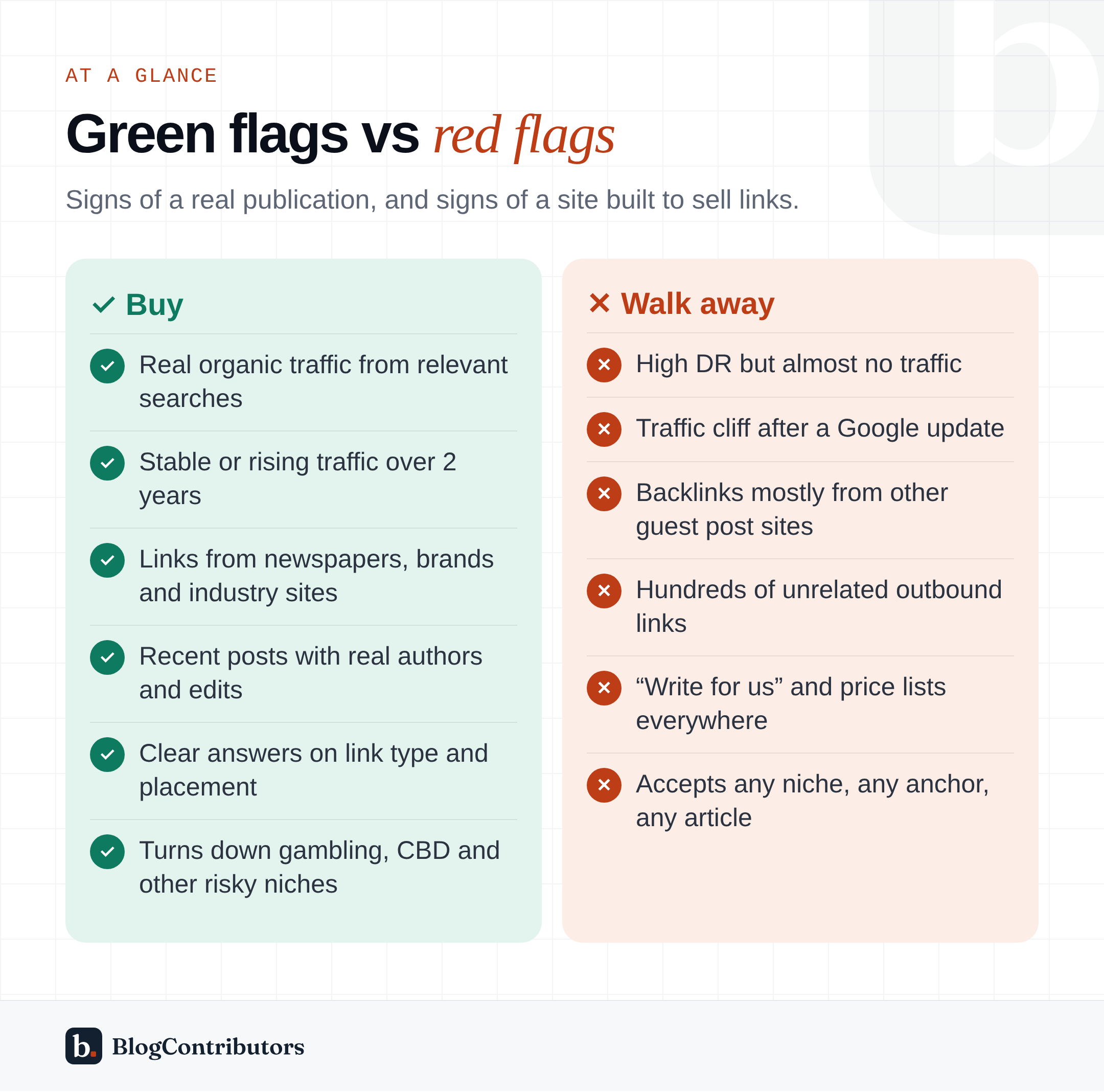
Start with estimated organic traffic in Ahrefs or Semrush. You are looking for a site that real people find through Google. As a rough floor, we want to see at least a thousand or so estimated monthly organic visits, and much more for higher prices.
This is the single most common gap we find. In our own listings, 16 of the 35 sites rated DR 70 or higher with traffic data get fewer than 10,000 estimated monthly visits. A high DR with very little traffic is a warning sign. It does not automatically rule a site out, but you should understand why before you pay. We cover this in detail in DR vs traffic: which metric matters more.
2. A steady or rising traffic trend
Look at the traffic graph for the last 12 to 24 months, not just today’s number. Healthy sites wobble but trend flat or upward.
Red flags:
- A cliff-edge drop that lines up with a Google core or spam update. The site may have been hit for a reason, and your link sits on it.
- A sudden spike from nothing. This can mean the site ranked briefly for a trending or irrelevant term, or that someone is inflating it before selling links.
- A long, slow decline. The site may be losing relevance, and the value of your placement will shrink with it.
3. Traffic from the right country
Check the country breakdown. If you sell to US customers, a site whose traffic comes mostly from another market may still pass some authority, but it will not send you relevant visitors. Also watch for sites whose traffic is spread oddly across countries that do not match their language or topic. That pattern often points to low-quality, scraped or programmatic content.
4. Traffic to real pages, not a handful of flukes
Open the “top pages” report. On a genuine publication, traffic is spread across many articles. If one or two pages bring almost all the visits, the site’s “traffic” may really be a single lucky ranking. Also check what those pages rank for. Traffic from coupon codes, celebrity net worth or “what time is it in…” searches is not a sign of a site your readers trust.
Authority checks
5. Who links to the site
In the referring domains report, sort by DR and scan the top 50. Good sites earn links from newspapers, industry sites, universities and well-known brands. Link sellers tend to collect links from other guest post sites, private blog networks and spammy directories.
A quick test: if most of the strongest referring domains are themselves guest post sites selling links, the DR is borrowed, not earned.
6. Outbound links and the “link farm” smell
Look at the site’s outbound links. Every site links out, but a site that links to hundreds of unrelated commercial pages each month (casinos, CBD, loans, essay writing, crypto) is selling links to anyone who pays. Google’s spam policies are clear that link schemes can be penalised. When a site gets caught, the links it sold lose their value, yours included.
7. Indexation and search visibility
Search Google for site:example.com and then for a recent guest post on the site. If recent articles are not indexed after a few weeks, Google may be ignoring part of the site. Also look up one of the site’s own article titles in quotes. If it does not show up, that is a serious warning.
Content checks
8. Topical fit with your website
Relevance matters more than raw authority. A link from a well-read marketing site to a SaaS product makes sense to both readers and search engines. The same link from a general “news” site that covers pets, plumbing and payday loans makes much less sense.
Ask yourself: would a reader of this site plausibly be interested in what I sell? If the honest answer is no, keep looking.
9. Editorial quality of recent posts
Read three or four articles published in the last month. Do they have a real author, sensible structure and accurate information? Are they written for readers, or stuffed with anchor text pointing to unrelated sites?
The recent posts are what your article will sit beside. If they are thin, keyword-stuffed or obviously AI-generated without editing, the site is not protecting its own quality. It probably won’t protect yours either.
10. Too many “sponsored” or “guest post” signals
Every guest post site accepts contributions. That is the point. But if the homepage is full of “Write for us”, “Submit a guest post”, “Advertise here” and price lists, or if most new articles are clearly paid placements, the site exists mainly to sell links. Search engines and readers both notice.
Placement checks
11. Link type and placement terms
Before you pay, get clear answers to these questions:
- Will the link be dofollow, nofollow or sponsored?
- How many links are allowed in the article, and can one point to a commercial page?
- Is the article permanent, or does it come down after a set period?
- Will the post be marked “sponsored” or placed in a hidden or orphaned section of the site?
- How long until it goes live?
Posts placed in a separate “partner” or “sponsored” section with no internal links from the rest of the site are often barely crawled. Ask where your article will appear and whether it will be linked from the category or homepage.
12. Proof that it actually goes live
The last check happens after you pay, and it is the one most buyers skip. When the post is published, confirm that:
- the URL loads and the article is complete,
- your link points to the right page with the agreed anchor text,
- the link attribute is what you agreed on, and
- the page is indexable (no
noindextag and not blocked by robots.txt).
Then check again after a few weeks. Links that quietly disappear or get switched to nofollow are a common problem in this industry.
A simple scoring system
You do not need a complicated spreadsheet. Score each site against the 12 checks:
| Score | What it means | What to do |
|---|---|---|
| 11–12 passes | Strong, genuine publication | Buy with confidence if the price fits |
| 8–10 passes | Decent site with some weaknesses | Buy if it is topically relevant and fairly priced |
| 5–7 passes | Mixed signals | Only for low prices and low-risk anchors |
| 0–4 passes | Built to sell links | Skip it, whatever the DR |
Weight checks 1, 5, 6 and 8 more heavily than the others. Real traffic, earned links, a clean outbound profile and topical fit are the four that most often separate good placements from wasted money.
Questions to ask before you pay
Metrics only tell part of the story. Before any purchase, get written answers to these questions from the publisher or the service you are buying through:
- Can you share two or three guest posts published on the site in the last month?
- Will the article be reviewed and edited by the site’s editor, or published as submitted?
- Which categories or sections will it appear in, and will it be linked from the homepage or a category page?
- Do you accept niches such as gambling, CBD or crypto? A “yes” to everything is a warning sign.
- What happens if the link is removed or changed after publication?
Vague or evasive answers are information too. A real publication knows its editorial process and is happy to explain it.
Tools you need (and what they cost)
You do not need an expensive stack to vet sites properly:
- Ahrefs or Semrush: for DR or Authority Score, traffic estimates, traffic history, top pages, referring domains and outbound links. Semrush offers a limited number of free searches, and a single paid month of either tool is enough to vet a large shortlist.
- Google search: for
site:checks, indexation and spotting obvious “write for us” footprints. - Your browser: for reading recent posts, checking the author pages and viewing the page source to confirm link attributes.
- A spreadsheet: one row per site, one column per check, plus price, niche and notes.
Expect to spend 10–15 minutes per site once you have done a few. Vetting 20 sites takes an afternoon. That is a small cost compared with spending thousands of dollars on placements that do nothing.
Common mistakes buyers make
Buying on DR alone
DR is easy to compare, so it becomes the deciding factor. It should be one of several. Two sites with DR 75 can be worlds apart: one with half a million monthly visitors and links from major newspapers, the other with a few hundred visitors and links from other guest post sites.
Chasing the cheapest price per DR point
Cheap high-DR placements are cheap for a reason. If a DR 80 site charges the same as a DR 40 site, it is usually because the publisher knows the site does not hold up to the checks above. We break down what fair prices look like in our guest post pricing guide.
Ignoring the article itself
A thin 500-word post with an awkward link does little for anyone. A well-researched article that readers actually use earns more internal links, stays live longer and sends real visitors. That is why every placement through BlogContributors includes an original 2,000–2,500 word article written by our team.
Never checking the link again
Set a reminder to check your placements at 30 days, 90 days and every six months after that. Keep a simple sheet with the URL, the target page, the anchor text and the date you last checked it.
How we apply these checks
Every site in our marketplace is reviewed against these checks before it is listed. Each listing shows its metrics with the date they were last verified in Ahrefs. When metrics have not been checked recently, the listing says so instead of showing an old number.
We also keep publisher contact details private and handle every order ourselves. We write the article, agree the placement with the site, publish it and send you the live link once it is verified. If a site no longer passes our checks, we take it off the marketplace.
That does not mean you should stop checking. A good buyer verifies everything, including us. Open any listing in the marketplace, run the checks above, and see whether the site holds up.
Quick reference: the 12 checks
- Organic traffic: real visitors, not just a high DR.
- Traffic trend: flat or rising over 12–24 months, with no cliff-edge drops.
- Country mix: traffic from the market you sell to.
- Top pages: traffic spread across many real articles.
- Referring domains: earned links from credible sites.
- Outbound links: no pattern of selling links to anyone.
- Indexation: recent articles appear in Google.
- Topical fit: the site’s readers would care about your product.
- Editorial quality: recent posts are written for readers.
- Sponsored signals: the site is a publication first, not a link shop.
- Placement terms: link type, number of links, permanence and location agreed up front.
- Live proof: the link is published as agreed and still there later.
Run these 12 checks on every site and you will avoid most of the placements that waste money. Ready to start? Browse verified websites or read how ordering works.