
DR vs Traffic: Which Metric Matters More When Choosing Guest Post Sites?
Domain Rating measures links. Organic traffic shows whether Google ranks a site. Real data from 61 websites shows how often they disagree, and which to trust.
When you choose a site for a guest post, two numbers usually decide it: the site’s Domain Rating (DR) and its organic traffic. Most marketplaces lead with DR because it is a single, tidy number from 0 to 100. Traffic is messier. It changes month to month, varies by tool, and is only an estimate.
But the two numbers measure very different things. When they disagree, which one should you trust? This guide explains what each metric means. It uses real data from the 63 sites in our marketplace to show how often they disagree, and gives you a simple way to decide.
Key takeaways
- DR measures backlink strength. Organic traffic shows whether Google actually ranks the site.
- In our marketplace, 16 of 35 sites rated DR 70+ get fewer than 10,000 estimated monthly visits.
- When the two disagree, real, relevant traffic is the stronger signal.
- Use both together: filter by relevance, set a traffic floor and use DR as a tie-breaker.
What Domain Rating actually measures
Domain Rating is a metric from Ahrefs. It scores how strong a website’s backlink profile is compared with every other site in Ahrefs’ index, on a scale from 0 to 100. A site gets a high DR by having links from many other sites that themselves have high DR.
Three things to understand about DR:
- It is about links, not readers. DR says nothing directly about whether anyone visits the site or whether Google ranks it.
- It is logarithmic. Going from DR 70 to DR 80 is much harder than going from DR 20 to DR 30.
- It is not a Google metric. Google does not use DR. It is a third-party estimate of link strength, and a useful one, but still an estimate.
Semrush’s Authority Score and Moz’s Domain Authority (DA) are similar metrics from other tools. The same strengths and weaknesses apply to them.
What organic traffic actually measures
Organic traffic in Ahrefs or Semrush is an estimate of how many monthly visits a site gets from Google search. The tool calculates it from the keywords the site ranks for, the positions it holds and the search volume of those keywords.
That makes it a proxy for something important: Google currently trusts this site enough to rank it. A site can inflate its DR with low-quality links, but it is much harder to fake sustained rankings across thousands of keywords.
Its weaknesses are real too. Estimates can be off by a wide margin. They miss traffic from keywords the tool does not track, and they do not include direct, social, email or referral visitors. Use the number for comparison and trends, not as an exact visitor count.
How often DR and traffic disagree
In theory, sites with strong backlinks should rank well and get plenty of traffic. In practice, the link between the two is loose. Across the 61 sites in our marketplace with traffic data, DR and traffic are only moderately related.
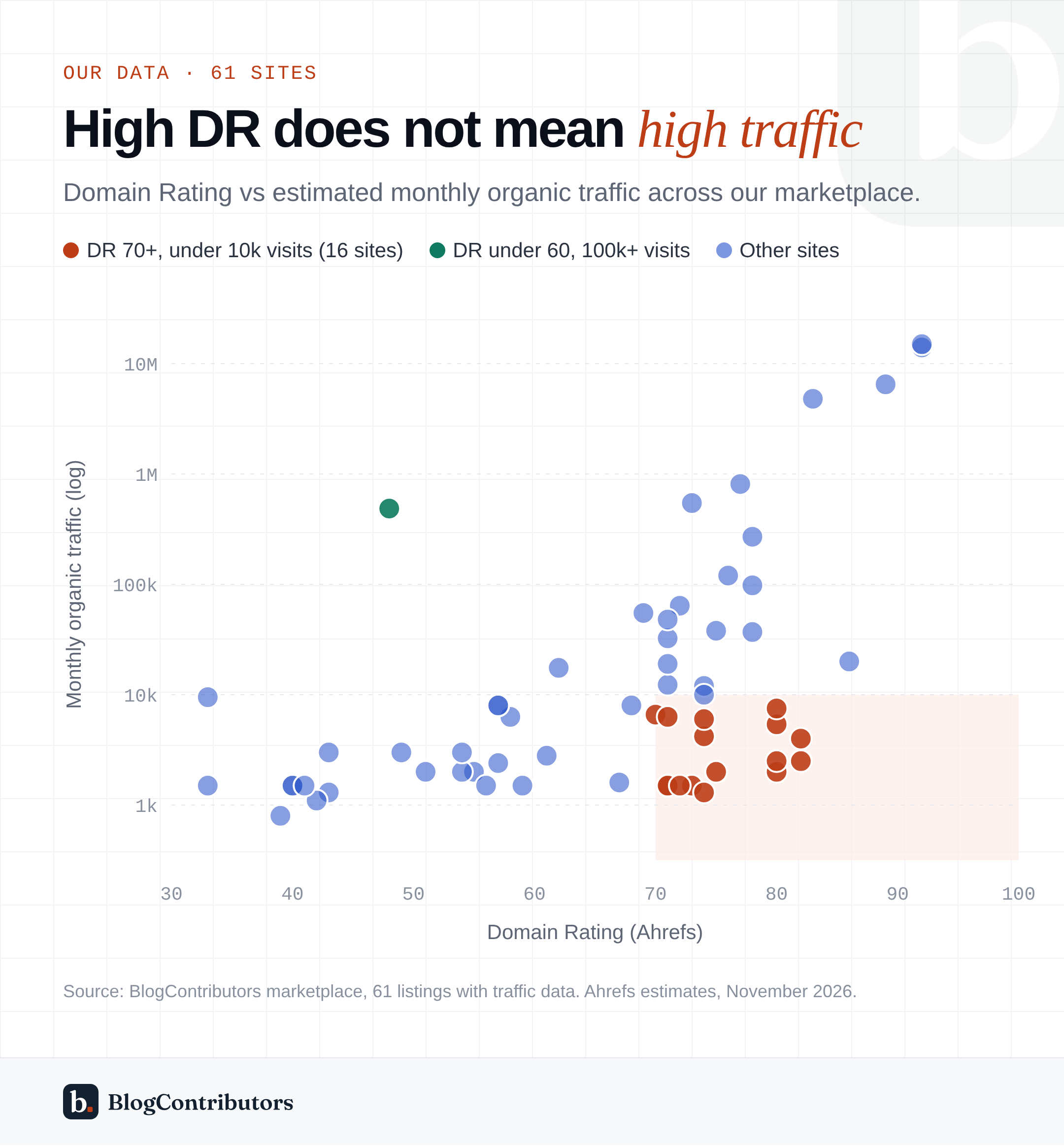
Some highlights from our own listings:
- High DR, low traffic is common. Of the 35 sites rated DR 70 or higher, 16 get fewer than 10,000 estimated monthly visits, and 11 get fewer than 5,000. Several DR 80+ sites get only 2,000–5,000 estimated monthly visits.
- Lower DR, high traffic happens too. One site in our marketplace has a DR of just 48 but an estimated 486,000 monthly organic visits. That is far more than most of the DR 70s and 80s.
- At the very top, both line up. Our two DR 92 sites each get millions of estimated monthly visits. When a site is genuinely one of the strongest on the web, both metrics usually agree.
Why high-DR sites can have low traffic
There are innocent reasons and less innocent ones.
Innocent reasons
- Brand or news sites: some well-known publications get most of their visitors directly, from social media or from Google News. The tools do not count that as organic traffic.
- Niche B2B publications: a respected trade site may rank for low-volume, high-value keywords. It reaches the right readers, but not many of them.
- A recent redesign or migration: traffic can dip for a few months after a site moves domains or restructures.
Warning signs
- Bought or swapped links: the site has built its DR with links from other guest post sites and networks, not from genuine coverage.
- Penalised or demoted content: the site was hit by a Google update and lost its rankings, but kept its backlinks, so DR stays high.
- An expired domain: someone bought an old domain with a strong link profile and put new, unrelated content on it.
If you see high DR and low traffic, check the traffic graph over the last two years. A healthy site that has always been small is very different from a site whose traffic fell off a cliff in the last update.
Why lower-DR sites can have high traffic
A site with modest DR but strong traffic usually ranks well because of its content rather than its links. It may answer questions people search for, cover a narrow topic thoroughly or simply be well built. Google is ranking it on merit.
These sites are often underpriced. Buyers filter them out by setting a minimum DR, so publishers cannot charge as much. A relevant placement on a site like this can send real visitors and pass genuine relevance signals.
Which one matters more?
If you have to pick one, pick traffic, as long as the traffic is genuine and comes from relevant topics and countries.
Here is why. The reason you want a link from a site is that search engines trust that site. Sustained organic traffic is direct evidence of that trust. DR is indirect evidence: it shows the site has links, and links are what search engines used to judge trust. When the two disagree, the direct evidence wins.
Our own pricing data reflects this. Across our listings, traffic predicts a site’s price slightly better than DR does, because experienced buyers already pay more for real audiences.
But you should not have to pick one. The best approach is to use both together.
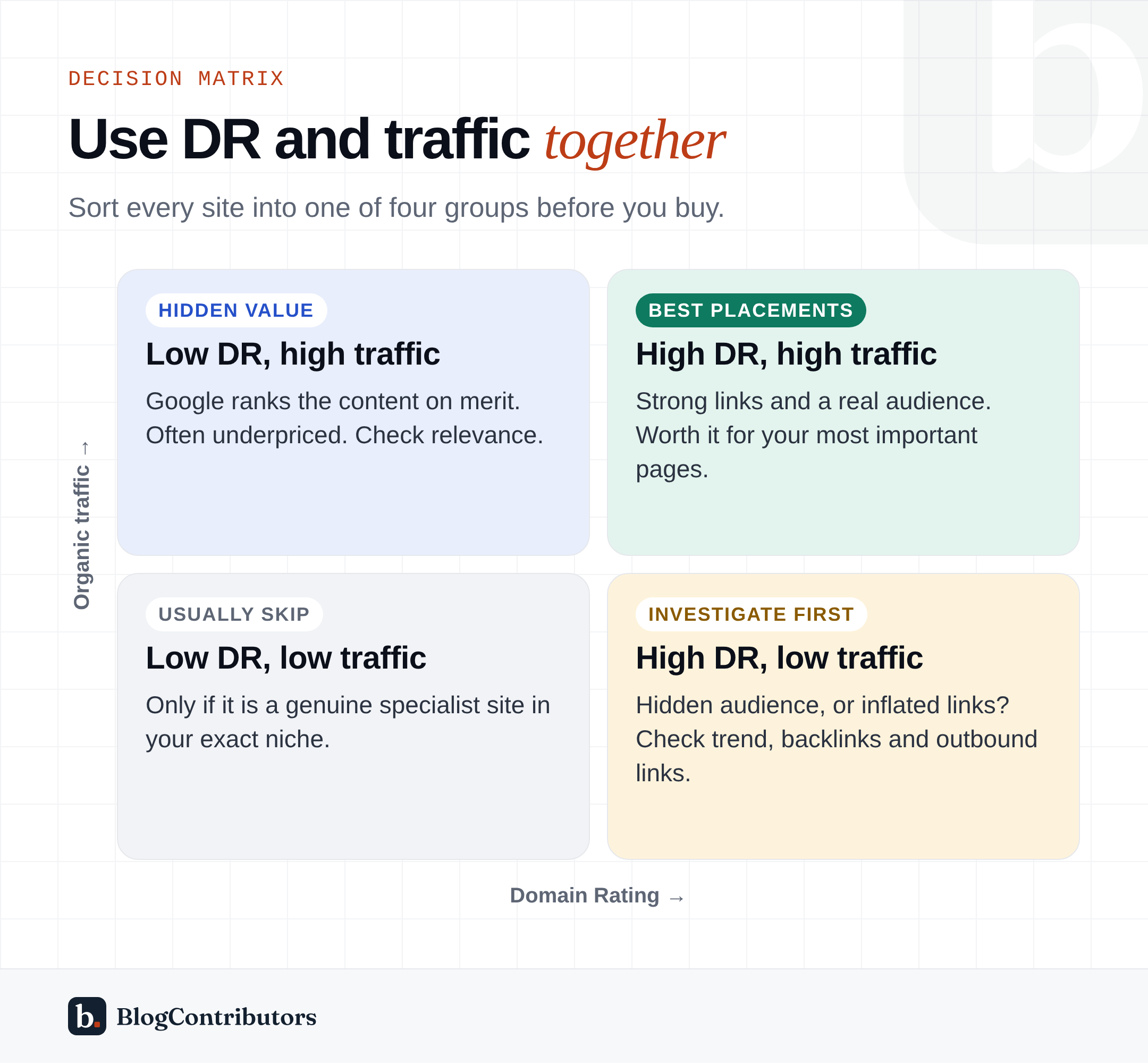
The four types of site
High DR, high traffic: the best placements
Strong links and a real audience. These are usually established publications with good editorial standards. They cost more and are worth it for your most important pages.
Low DR, high traffic: hidden value
Google likes the content even without a huge link profile. These sites are often underpriced and can be excellent for relevance and referral visitors. Check that the traffic is real and relevant to you.
High DR, low traffic: investigate first
This could be a respected brand with traffic the tools do not see, or a link seller with an inflated profile. Run the checks in our 12-point vetting checklist before you buy. Pay particular attention to the traffic trend, referring domains and outbound links.
Low DR, low traffic: usually skip
Unless the site is a perfect topical fit, such as a small but genuine specialist blog in your exact niche, there is little reason to pay for a placement here.
A worked example: two sites, one budget
Imagine you have $400 and two options in the business niche. These are illustrative figures based on patterns we see often:
| Site X | Site Y | |
|---|---|---|
| DR | 81 | 58 |
| Estimated monthly organic traffic | 2,400 | 38,000 |
| Organic keywords | 900 | 21,000 |
| Traffic trend (24 months) | Down 70% after a core update | Steady growth |
| Top referring domains | Mostly other guest post sites | Industry blogs, a few news mentions |
| Price | $400 | $400 |
On a DR filter, Site X wins easily. On everything else, Site Y is the better placement. It ranks for 23 times as many keywords, its traffic is growing, and its links look earned. Site X’s high DR is largely left over from a profile that Google has already stopped rewarding with rankings.
Buyers who filter to “DR 70+” never even see Site Y. That is the single most common way people overpay.
Do Ahrefs and Semrush agree?
Not exactly. Each tool has its own crawler, keyword database and traffic model, so the numbers differ, sometimes by a lot. A site might show 20,000 monthly visits in one tool and 35,000 in the other.
That is fine, as long as you compare like with like. Pick one tool as your source of truth and use it for every site on your shortlist. Use the second tool only to sanity-check surprising numbers. If both tools agree that a site’s traffic is tiny or falling, believe them.
Our marketplace uses Ahrefs for every listing, so the DR and traffic numbers are comparable across sites.
Other metrics worth a glance
DR and traffic are the headline numbers, but a few others help confirm what you are seeing:
- Organic keywords: how many keywords the site ranks for. Thousands of keywords spread across many pages is a good sign.
- Referring domains: how many unique sites link to it, and whether they look genuine.
- Traffic value: the estimated cost of buying the same traffic through ads. A high value means the site ranks for commercially useful keywords.
- Traffic by country: whether visitors come from the market you care about.
Traffic quality beats traffic quantity
Not all traffic is equal. Before you trust a big traffic number, open the top pages report and look at what the site ranks for. A business site whose visitors arrive from searches about small business finance, hiring or marketing has an audience your brand can use. A site whose traffic comes from song lyrics, celebrity gossip or random “how to” queries has numbers, but not readers who care about your product. Relevant traffic from the right country is worth far more than a larger total built on unrelated searches.
How to use this in practice
Here is a simple process when you shortlist sites:
- Filter by relevance first. Start with sites in your niche or a closely related one.
- Set a sensible traffic floor. For most buyers, a few thousand estimated monthly visits is a reasonable minimum. Raise it for more expensive placements.
- Use DR as a tie-breaker. Between two similar sites with similar traffic, prefer the one with the stronger, cleaner link profile.
- Check the trend. A rising or stable site is a better long-term home for your link than one that is sliding.
- Compare price against traffic. Divide the price by monthly traffic in thousands to compare value across sites. Our guest post pricing guide explains how.
Frequently asked questions
Is there a minimum DR I should accept?
There is no magic number. A DR floor is a reasonable shortcut for filtering out obvious junk, but set it low enough (for example 30–40) that you do not exclude relevant sites with real traffic. Then judge each site on traffic, relevance and the other checks.
Can a site’s traffic be faked?
Estimated organic traffic is hard to fake for long, because it depends on real rankings. It can be inflated briefly by ranking for irrelevant or trending keywords, which is why the traffic trend and the top pages report matter. Referral or direct traffic claims in a publisher’s media kit are much easier to exaggerate. Trust third-party organic estimates over screenshots.
Does DR still matter at all?
Yes. Between two relevant sites with similar traffic, the one with the stronger, cleaner backlink profile is usually the better placement. DR is a useful signal. It just should not be the only one.
How we show these metrics
Every site in our marketplace shows DR and estimated organic traffic from Ahrefs, along with the date they were last checked. Each site’s profile page also shows a traffic chart once we have more than one verified check, so you can see the trend, not just today’s number. If a metric has not been verified yet, we show “Checking” instead of an old or unconfirmed number.
You can filter the marketplace by DR range and by minimum traffic, and sort by highest DR or most traffic. Try sorting by traffic instead of DR. You may find sites you would otherwise have filtered out.
Browse sites sorted by traffic or sort by highest DR and compare the two lists.