
Guest Post Pricing in 2026: What You Should Actually Pay (and Why Prices Vary So Much)
Real guest post prices from 63 verified websites: a $300 median, a $200–$1,800 range, what drives the differences and the hidden fees to ask about.
Ask ten publishers what a guest post costs and you will get ten different answers. One site charges $50, another charges $2,500, and the DR numbers often do not explain the difference. Some quotes include the article, and others charge extra for it. Some links stay forever, while others vanish after a year.
This guide breaks down what actually drives guest post prices in 2026. It uses real numbers from the 63 websites currently listed in our marketplace, so you can tell a fair quote from a bad one.
Key takeaways
- Across our 63 verified listings, guest posts cost $200–$1,800, with a median of $300.
- Price rises with authority, but traffic, niche and editorial standards explain more of the difference than DR alone.
- Always compare the total cost, including the article, link type and extras, not the headline price.
- The best value is usually a relevant site with real traffic in the $200–$500 range.
The short answer
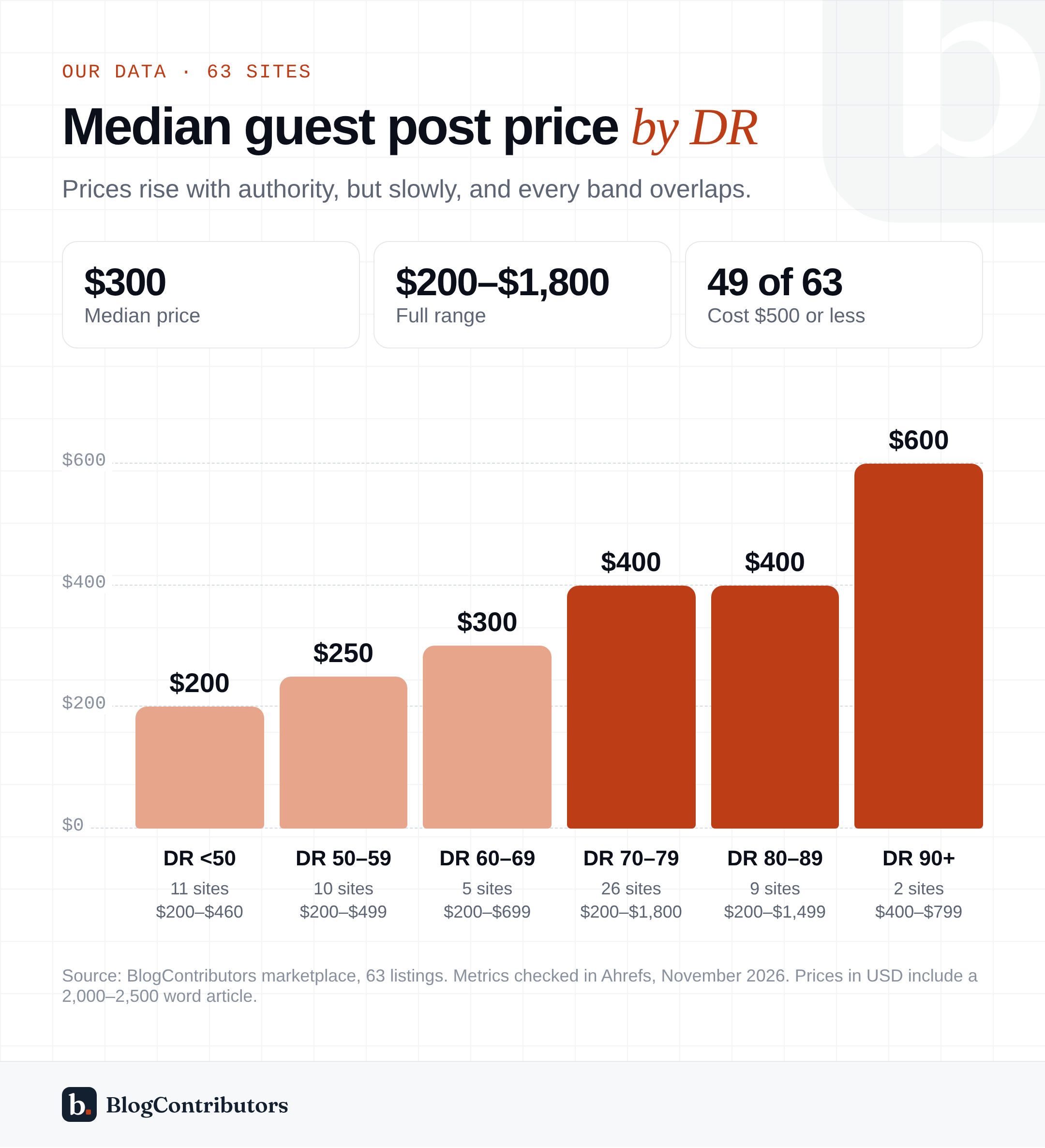
Across our 63 verified listings, the prices range from $200 to $1,800 per guest post. The median is $300, and more than three-quarters of sites (49 of 63) cost $500 or less. Every price includes an original 2,000–2,500 word article, placement on the site and verification of the live link.
Prices rise with authority, but not in a straight line. That is the most useful thing to understand before you buy.
What our own data shows
Grouping our listings by Domain Rating gives a clear picture:
| DR band | Sites | Median price | Price range |
|---|---|---|---|
| Under 50 | 11 | $200 | $200–$460 |
| 50–59 | 10 | $250 | $200–$499 |
| 60–69 | 5 | $300 | $200–$699 |
| 70–79 | 26 | $400 | $200–$1,800 |
| 80–89 | 9 | $400 | $200–$1,499 |
| 90+ | 2 | $600 | $400–$799 |
Three things stand out.
The median rises, but slowly. Moving from a DR 50s site to a DR 70s site raises the median price from $250 to $400. That is a real increase, but not the five-fold jump many people expect.
The ranges overlap heavily. You can find a $200 placement in the DR 80s and a $460 placement under DR 50. DR alone does not set the price.
The most expensive sites are not always the highest DR. Our single most expensive listing is a DR 78 business site at $1,800, more than double the price of either of our DR 92 sites. Its price is driven by much more than its DR.
The six factors that drive guest post prices
1. Real organic traffic
Traffic is the factor that best explains price differences between sites with similar DR. In our data, a site’s estimated organic traffic predicts its price slightly better than its DR does. A site that Google sends hundreds of thousands of visitors to each month can charge far more than a site with the same DR and a few thousand visitors.
That is also how it should be. Traffic shows that Google trusts the site enough to rank it, and that your article may be read by real people.
2. Domain Rating and backlink profile
DR still matters. Sites with strong, earned backlink profiles pass more authority, and publishers price that in. But treat DR as a starting point, not the answer. A DR 80 site that charges the same as a DR 40 site is usually priced low because it fails other checks. Our 12-point vetting checklist explains what to look for.
3. Niche
Some niches cost more because advertisers in them pay more. Finance, insurance, legal, crypto, health and software sites often charge a premium, because a single customer is worth a lot to buyers in those industries. General business and lifestyle sites are usually cheaper.
Many sites also charge extra for “grey” niches such as gambling, CBD, adult or crypto, or refuse them entirely. We do not accept orders for those niches at all.
4. Link type and placement terms
Dofollow links cost more than nofollow or sponsored-tagged links. Permanent placements cost more than ones that expire after a set time. Some sites also charge more for a link to a commercial page (a pricing or product page) than to an informational blog post. Read our guide on dofollow vs sponsored links before paying a premium for link type.
5. Editorial standards
Strict publications reject weak articles, edit heavily and refuse obvious anchor text. That makes placements harder to get, so they cost more, but the link sits on a site that protects its quality. Sites that accept anything are cheaper, and the same lack of standards also makes them riskier.
6. What’s included
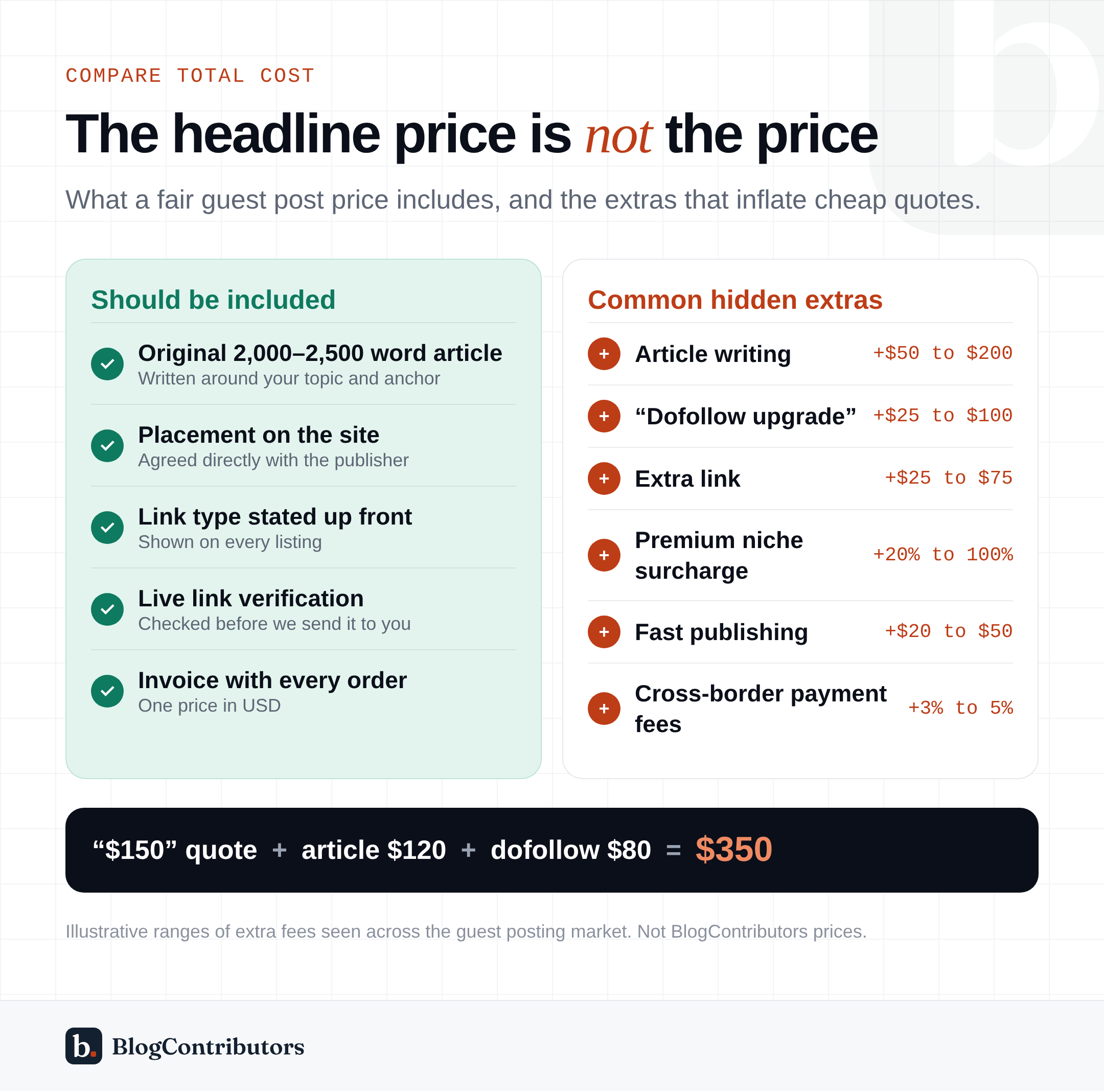
This is where many quotes are hard to compare. A “$150 guest post” can turn into $400 once you add the article, a second link, a do-follow upgrade and a “fast publishing” fee.
Prices by niche in our marketplace
Niche shapes prices too. Our listings are weighted towards business publications, but the pattern is still visible:
| Niche | Sites | Median price |
|---|---|---|
| Business | 50 | $300 |
| Technology | 2 | $275 |
| News | 7 | $400 |
| Marketing | 2 | $400 |
| Finance | 1 | $599 |
News sites cost more because they tend to have bigger audiences and stricter editors. Finance sites cost more because finance advertisers pay more for every customer. Treat the small groups as examples rather than averages. One or two sites cannot tell you what a whole niche costs.
Hidden costs to ask about
Before you compare two quotes, ask each publisher or provider these questions:
- Is the article included? Writing a good 2,000-word article costs real money. If you have to write it yourself, add your own time or a writer’s fee to the price.
- Are there content fees for certain topics? Some sites add a surcharge for finance, tech or other “premium” topics.
- Is the link dofollow by default? Some sites quote a nofollow price and charge extra for dofollow.
- How many links are allowed? A second link often costs extra.
- Is the placement permanent? A post that is removed after 12 months costs more over time than it first appears.
- Who pays for revisions or rejections? If the editor rejects the article, do you pay again?
- Are there payment or currency fees? Paying a publisher in another country can add 3–5% in fees.
Cheap vs expensive: what you are really paying for
The $20–$80 guest post
Very cheap placements are almost always on sites that exist to sell links. They tend to have little real traffic, a long list of unrelated outbound links and recent posts that no one reads. The link might help a little, or it might not be counted at all. At worst it adds to a pattern that search engines treat as manipulative.
The $200–$500 guest post
This is where most good-value placements sit, and where most of our listings fall. You can find established business, marketing and niche publications with real traffic, decent editorial standards and dofollow links in this range.
The $500–$2,000+ guest post
At the top end you are paying for big audiences, strong brands and strict editors. These placements make sense for important pages, such as a core product page, a big content asset or a launch. They are a poor fit for testing anchor text or building volume.
How to calculate value, not just price
A simple way to compare placements is to look at cost against the things that actually help you:
- Relevance: would this site’s readers care about your product? If not, discount it heavily, whatever the price.
- Traffic: divide the price by the site’s monthly organic traffic in thousands. A $400 post on a site with 40,000 monthly visitors costs $10 per thousand visitors. A $400 post on a site with 2,000 monthly visitors costs $200 per thousand visitors.
- Authority: compare DR within the same niche and traffic level.
- Total cost: include the article, any extra fees and your own time.
The cheapest placement per DR point is rarely the best buy. The best buy is usually a relevant site with real traffic at a fair price.
A worked example: comparing three quotes
Say you sell accounting software and you are choosing between three placements. These are illustrative quotes, not real sites:
| Site A | Site B | Site C | |
|---|---|---|---|
| Niche | General “news” | Small business | Finance |
| DR | 82 | 64 | 74 |
| Monthly organic traffic | 3,000 | 45,000 | 60,000 |
| Headline price | $150 | $350 | $600 |
| Article included? | No (+$120) | Yes | Yes |
| Dofollow included? | +$80 | Yes | Yes |
| Total cost | $350 | $350 | $600 |
| Cost per 1,000 monthly visitors | $117 | $7.80 | $10 |
Site A looks cheapest and has the highest DR. Once you add the extras, it costs the same as Site B, with a fraction of the audience and no topical fit. Site B is the best value here. Site C costs more but is the most relevant, which makes it a good home for a link to an important page.
This is the comparison that matters: total cost against relevance and real audience, not headline price against DR.
When a premium placement pays off
Expensive placements are not always better value, but they make sense when:
- the link points to a high-value page, such as a core product page, where small ranking gains bring real revenue,
- the site’s readers are your exact buyers, so the article itself can send customers,
- you are competing against sites that already have links from similar publications, and
- the brand association matters, such as being featured on a site your prospects recognise.
For testing a new page, building volume or supporting blog content, mid-range placements are usually the better buy.
Budget planning: how much should you spend?
How much you need depends on your competition, but a few rules of thumb help:
- Testing the channel: start with 3–5 placements at $200–$400 each on closely relevant sites. Budget: roughly $1,000–$2,000.
- Steady growth: 4–8 placements a month, mixing a few stronger sites with mid-range ones. Budget: roughly $1,500–$4,000 a month.
- Competitive niches: software, finance and legal often need more and stronger placements over a longer period.
Spread your placements over months rather than buying them all at once. A natural link profile grows steadily. If you work in SaaS, our 90-day guest posting plan for SaaS shows how to pace a budget.
Why we charge one price per site
We built BlogContributors to make guest post pricing simple. Each site in our marketplace has one price in USD. That price includes:
- an original 2,000–2,500 word article written by our team around your topic and anchor text,
- placement on the site, handled directly with the publisher,
- verification that the post is live and the link works as agreed, and
- an invoice for every order.
There are no extra content fees, no surprise “dofollow upgrade” charges and no separate writing invoice. You see the price, the site’s metrics and the date they were last checked before you add it to your cart.
A quick checklist before you pay
- Have you checked the site’s real organic traffic and trend, not just its DR?
- Is the site relevant to your business?
- Do you know exactly what the price includes?
- Have you agreed the link type, the number of links and whether the post is permanent?
- Does the price sit sensibly against similar sites in the same niche and DR band?
If the answer to all five is yes, you are probably paying a fair price.
Frequently asked questions
Why do prices vary so much between similar sites?
Publishers set their own prices, based on demand, their editorial standards and how many placements they want to accept. Two sites with similar metrics can differ by hundreds of dollars. That is why comparing many listings side by side helps.
Are guest post prices negotiable?
Sometimes, especially for bulk orders placed directly with publishers. Negotiating takes time, though, and very low prices often come with conditions, such as shorter articles, extra fees or links that are removed later.
Do prices change over time?
Yes. When a site’s traffic grows, its price usually rises. When it loses traffic after a Google update, prices often fall, sometimes for good reason. Recheck metrics before every purchase, not just the first one.
Compare real prices side by side: browse the marketplace sorted by price, or see how our pricing works.